Wire-free bras are often dismissed as "comfort bras, not support bras" — a holdover assumption from the 1990s when wire-free meant unstructured. Modern wire-free engineering changed that, especially for larger cup sizes. Here's a real comparison: when underwire wins, when wire-free wins, and the cup-size threshold at which most people benefit from switching.
What each structure actually does
Underwire bras use a semi-rigid wire (usually metal, sometimes plastic) curved along the cup bottom. The wire lifts the cup from underneath, transmits support from the band to the cup, and defines the bottom-of-bust silhouette.
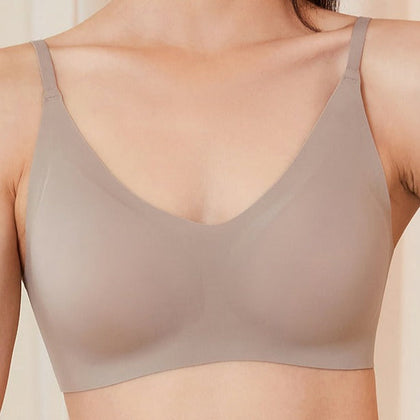
Wire-free bras use engineered fabric — seaming, paneling, and tension zones — to create the same lift through textile structure alone. The band itself is typically wider or more structured than an underwire bra's band, because it's doing more of the work.
Neither is categorically better. They're different engineering approaches to the same problem, with different trade-offs.
When underwire wins
- Defined silhouette matters (evening wear, fitted clothing). Underwires give a precise bottom-of-bust line that wire-free structures can't match.
- Projected bust shape. If you want a rounder, more-forward projection, underwire delivers it more predictably.
- Very small cup sizes where the wire weight isn't noticeable. A-B cups often don't feel much difference in weight, so the shape advantage wins.
- High-impact sports. Encapsulation sports bras (common for running, D+ cups) usually combine underwire with compression. Wire-free sports bras for D+ exist but are a newer category.
When wire-free wins
- Comfort over long days. No pressure points at the underbust. No digging after 6+ hours wear.
- Between-size or narrow-rib body. Underwire shape is standardized; if your ribs don't match the wire's curvature, it digs in one spot. Wire-free flexes with your body.
- Post-surgery (mastectomy, augmentation, reduction, or lift). The American Society of Plastic Surgeons' standard guidance is wire-free for 6-12 weeks post-op, often permanently for sensitive patients.
- Pregnancy and nursing. Breast tissue changes rapidly; wire-free adapts. Underwire can obstruct milk ducts in some cases.
- Larger cups (DD+, especially G+). Counter-intuitive but true: wire-free engineered for larger cups often feels more supportive, because the whole bust is held in a textile cradle rather than lifted by a wire that may compress tissue.
- Overnight wear or lounging. Many wire-free styles can be worn continuously, including to sleep. Most people shouldn't sleep in underwires.
- Skin conditions (eczema, psoriasis, rosacea at pressure points). Wire pressure aggravates; wire-free doesn't.
The cup-size threshold
Common wisdom used to be "wire-free is only for smaller cups." The engineering reality now is the opposite: above a D cup, a well-designed wire-free bra often outperforms an underwire in all-day comfort AND support.
Why: larger cups carry more weight. An underwire is a narrow pressure line transmitting all that weight to a small area of underbust. A wire-free bra with a structured band distributes the same weight across a much larger area. For women in the 34G-46J range — the sizing band where The Full Support Bra is engineered — this distribution difference is significant.
Below a DD cup, underwire vs wire-free is mostly a preference question. Above DD, the physical advantage shifts.
The "wire-free is flat-looking" objection
This used to be true. Early wire-free designs compressed rather than shaped — the "uni-boob" silhouette. Modern wire-free construction uses:
- 3-part cup construction — upper, lower, and side panels create shape without wire
- Mid-cup seaming — lift point without a wire
- Power mesh side wings — prevent underarm bulge without compression
- Wider band with boning or reinforcement — structural anchor
A well-engineered wire-free bra in the right size produces a round, supported shape — not a flat one. The difference vs underwire is in the precision of the silhouette (underwire is more precise), not the presence of shape.
Health and safety — the myths
- Do underwires cause breast cancer? No. The peer-reviewed research (cited via AMA/ASA reviews) consistently shows no causal link between bra-wearing and breast cancer. This myth circulated in the 2000s and has been thoroughly debunked.
- Can underwires cause pressure damage? In ill-fitting bras, yes — localized pressure under a too-small or too-rigid wire can cause bruising, inflammation, and in rare cases skin breakdown. The solution is fit, not avoiding underwires entirely.
- Wire-free is safer? Not safer — different trade-offs. A well-fit underwire is fine. A poorly-fit wire-free doesn't solve the fit problem.
The realistic "when to choose which" summary
| Situation | Better choice |
|---|---|
| Small cup (A-B), short wear time, fitted clothing | Underwire (silhouette) |
| Larger cup (D+), all-day wear | Wire-free |
| Full support large cup (G+) | Wire-free (engineered support) |
| Pregnant or nursing | Wire-free |
| Post-surgery (0-12 weeks) | Wire-free (ASPS guidance) |
| Running / high-impact sport | Either — depends on product engineering |
| Evening / special occasion | Underwire (precision shape) |
| Sensitive rib cage, between sizes | Wire-free |
Related reading
- How to measure your bra size correctly — the +4 method is wrong.
- Why most bras don't fit 34G-46J — what larger-cup wearers actually need.
The Only Bra lineup
- Full Support Bra — wire-free, full support 34G-46J.
- Scoop Camisole Bra — built-in cami, wire-free.
- The Only Adjustable Bra — adjustable fit, wire-free.
- The full lineup.
References
- Bra design and breast support biomechanics — PubMed / Sports Med (accessed 2026-04-22)
- American Society of Plastic Surgeons — Bra recommendations after surgery — American Society of Plastic Surgeons (accessed 2026-04-22)
- Underwire bra pressure points and skin health review — PubMed / Chiropr Osteopat (accessed 2026-04-22)
- Fabric-only support systems for larger cup sizes — fit research — PubMed / Int J Cloth Sci Tech (accessed 2026-04-22)
Discover more from The Only Bra or browse the full The Only Bra collection.
Frequently asked
What does "Wire-Free vs Underwire Bras — When Each Actually Makes Sense" cover?
This piece walks through the topic, context, and practical implications laid out in the article body above — focused on giving you a clear, sourced read rather than a quick listicle. Use it to deepen your understanding of the brand, category, or product family discussed.
Who is this article written for?
Readers shopping the brand or category covered, plus curious browsers researching independent makers stocked at Curated Sense. Both casual shoppers and trade buyers will find the same source-linked perspective.
How does Curated Sense vet the brands featured in journal articles?
Every brand in our journal has been onboarded directly: live inventory sync with the brand's own catalog, links back to the maker's own .com, and quality checks against return-rate, fulfillment-time, and customer-message-volume thresholds. We don't run sponsored placements in our journals.
Where can I shop the products discussed in this article?
Open the brand's collection or sub-collection page linked above to see current stock. Each product card opens a full Curated Sense product page with sizing, materials, the maker's own description, and the brand's live shipping policy.