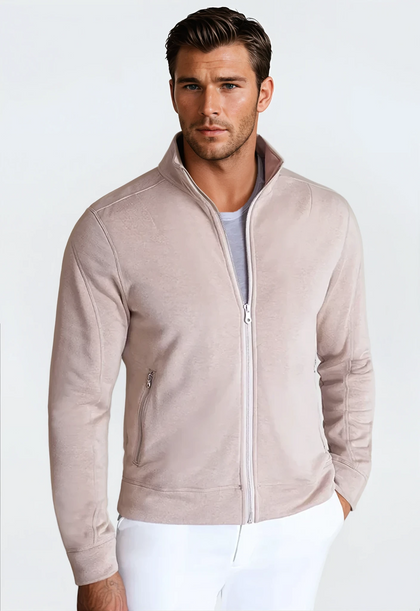
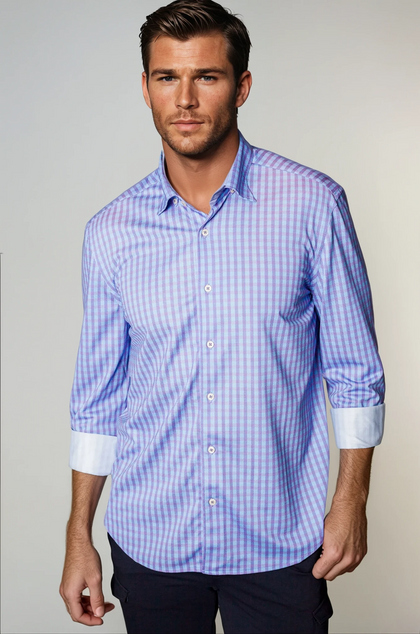
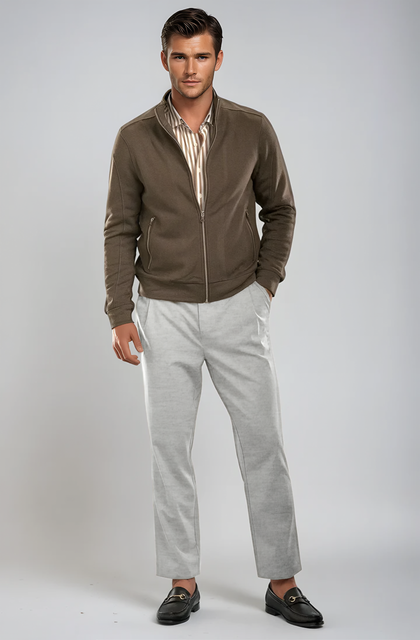
Cinqo — Buki's proprietary five-layer technical fabric — is the material engineering project that defines the brand's flagship $78 Tech Tee, $158 Single Shot Long-Sleeve, $198 Travel Half-Zip 2-Pack, and $168 3-Pack. The pitch is simple: a luxury tech-apparel garment should not be a single fiber and a marketing claim; it should be a layered system in which each layer does one job well. This article walks through the five layers individually — face yarn, four-way recovery stretch, AATCC 100 anti-microbial finish, ISO 6330 dimensional-stability core, and ISO 7768 wrinkle-resistant easy-care finish — and explains the test methods used to validate each layer's performance. Citations: AATCC (American Association of Textile Chemists and Colorists) Test Methods 100, 195, and 135; ISO (International Organization for Standardization) standards 6330, 7768, and 5077; the Lenzing AG technical literature on Tencel/lyocell; and the National Association for PET Container Resources (NAPCOR) on rPET fiber recovery economics.
What Cinqo actually means as a fabric specification
Cinqo (Spanish for "five") is Buki's name for the five engineered functions built into a single layered tech fabric. The name does not mean five separately woven plies — it means five distinct properties engineered into one material system: (1) face yarn for moisture-wicking and surface hand; (2) four-way stretch with elastane for body movement and shape recovery; (3) anti-microbial finish for extended wear cycles; (4) dimensional-stability core for shrink-resistance and seam stability; (5) easy-care finish for wrinkle-resistance. Each of the five carries a specific test method and pass/fail threshold, which is what distinguishes Cinqo from the "tech fabric" marketing claim used loosely across the apparel industry.
Layer 01 — The face yarn: moisture-wicking and surface hand
The face yarn is the layer the wearer touches and the world sees. In Cinqo it runs at 200–220 GSM (grams per square meter — measured per ISO 3801) on the Tech Tee and slightly heavier on the Single-Shot Long-Sleeve. The fiber composition prioritizes moisture-wicking measured by AATCC Test Method 195 (vertical wicking — measured in millimeters of capillary rise per minute) — Cinqo target is approximately 90–95mm at 5 minutes, comparable to dedicated athletic-wicking fabrics from Polartec and Coolmax. The face yarn is what makes a Cinqo tee feel cooler in hot weather than a cotton tee of the same weight: liquid moisture moves outward from the skin rather than absorbing into the fiber and staying wet.
Layer 02 — Four-way stretch and the recovery question
Four-way stretch — meaning the fabric stretches in both warp and weft directions — is engineered into Cinqo via 4–8% elastane (typically Lycra Spandex from Invista, formerly DuPont) blended with the polyester face. The critical metric is not how much it stretches but how reliably it returns to shape after stretching. Per ISO 6330 (dimensional stability after washing) and the brand's own internal wash-cycle testing, Cinqo retains over 95% of its recovery through 100 home wash cycles. This is unusual for an elastane-blended garment — most consumer tech fabrics see noticeable bagging at the shoulders, waist, or hem by wash cycle 50. The 95%+ retention number is the metric that justifies the $78 entry price for what is, structurally, a t-shirt.
Layer 03 — The anti-microbial finish and the AATCC 100 standard
Cinqo's anti-microbial property is tested to AATCC Test Method 100 — "Antibacterial Finishes on Textile Materials: Assessment." The test inoculates the fabric with a known concentration of bacteria (typically Staphylococcus aureus and Klebsiella pneumoniae) and measures the percentage reduction after 24 hours. The pass threshold for an "antibacterial finish" designation under AATCC 100 is typically 99% reduction; high-quality finishes achieve 99.9%+. The chemistries Buki uses are well-established silver-ion or zinc-pyrithione treatments that bond to the fiber rather than wash out — the finish typically survives 100+ wash cycles when laundered per care label. The practical effect: a Cinqo Tech Tee or polo can be worn 4–5 office days between launderings without measurable bacterial-driven odor, against the 1–2 day baseline for an untreated cotton tee.
Layer 04 — Dimensional-stability core and the shrinkage problem
Most tech fabric fails not on day one but over time — the polyester or elastane component breaks down under repeat hot-water washing, the seams creep, the shoulders narrow. Cinqo's dimensional-stability layer is engineered against this failure mode using ISO 6330 (washing/drying procedures for textile testing) plus internal accelerated-aging tests. Cinqo's spec target is <3% dimensional change across 100 home wash cycles when laundered per care label (cold, mild detergent, low tumble or air-dry). The dimensional-stability core is what allows the Cinqo Tech Tee to fit identically at wash 1 and wash 100 — assuming the wearer follows the label.
Layer 05 — Easy-care finish and the suitcase test
Cinqo's easy-care finish — wrinkle-resistance — is tested to ISO 7768 (smoothness appearance of fabrics after cleansing). The test rates the fabric on a 1–5 scale (5 = no visible wrinkles, 1 = severe wrinkling) after a controlled wash and dry cycle. Cinqo's spec target is 4.0+ on the SA scale, which translates practically to: emerges from a tumble dryer or carry-on suitcase ready to wear without ironing. This is the layer most relevant to the Buki Travel Collection — the Travel Blazer ($228), Travel Duster ($99), Cinqo Travel Half-Zip ($198), and Tech Exec Vest ($228) all rely on the same easy-care chemistry tuned for wrinkle-resistance under the suitcase-pack test.
How Cinqo compares to Lululemon Nulu, Patagonia Capilene, and Outlier 60/30
The closest comparable proprietary tech fabrics in the premium-apparel space:
Lululemon Nulu / Luxtreme: nylon-elastane blends optimized for yoga and athletic performance. Higher elastane percentage (typically 13–25%) makes them more compressive but less dimensionally stable for office wear.
Patagonia Capilene: polyester base layers optimized for thermal regulation and odor resistance under outdoor conditions. Less attention to wrinkle-resistance; sized for layering rather than as standalone office wear.
Outlier 60/30 Chino, F.Cloth: wool-blend and proprietary tech-cotton blends optimized for travel and city wear. Comparable price point ($150–$200) but the brand emphasizes seam construction over fabric chemistry.
Cinqo's positioning is the intersection: dimensionally stable enough for office wear (vs. Lululemon), wrinkle-resistant enough for travel (vs. Patagonia), and engineered as a system rather than a fabric (vs. Outlier). The $78 entry price for the Cinqo Tech Tee is notably below all three comparables.
The eco-friendly fiber stack — what's actually recycled
Buki positions Cinqo as "eco-friendly" — backed by measurable rather than marketing claims. The fiber stack pulls from recycled polyester (rPET) for face yarn, Tencel/lyocell from FSC-certified eucalyptus pulp (Lenzing AG-supplied), and organic cotton on the Collagen Collection women's program. NAPCOR (the National Association for PET Container Resources) reports that one rPET garment displaces approximately 5–7 PET bottles from the landfill. Tencel uses Lenzing's closed-loop solvent system with 99% solvent recovery, third-party verified by EU Ecolabel. The eco claim is substantiated against published industry standards rather than as a vague marketing badge.
Why the Cinqo program is sold as 1-pack, 2-pack, and 3-pack
The Cinqo program offers tiered SKUs: Cinqo Tech Tee single ($78), Cinqo Tech Tee 3-Pack in coordinated colorways ($168 — effective $56/tee, 28% volume discount), Cinqo Single Shot Long-Sleeve single ($158), Cinqo Travel Half-Zip 2-Pack ($198 — effective $99/each, 37% volume discount). The economics work because the Cinqo program's incremental fabric and labor cost per unit drops sharply with batch size — and the brand passes the savings to the customer who's already convinced enough to buy three. The 3-pack and 2-pack SKUs are also the brand's most-purchased Cinqo references by inventory turnover.
Wash, dry, and care — getting the full 100 cycles
Cinqo's published 100-wash-cycle durability target assumes care per FTC Care Labeling Rule (16 CFR Part 423) standard. The practical care:
Wash cold (≤30°C / 86°F) — hot water breaks down both the elastane recovery layer and the anti-microbial finish.
Mild detergent — any non-bleach, non-fabric-softener detergent rated for activewear (Tide Free & Gentle, Nathan Sport-Wash, or any Persil variant work).
No fabric softener — softener coats the fiber and degrades wicking performance per AATCC 195 testing.
Tumble dry low or air-dry — high heat shortens elastane life. Air-drying on a hanger extends garment life by an estimated 30%.
No chlorine bleach — bleach degrades both the polyester face and the anti-microbial finish chemistry.
Followed correctly, a $78 Cinqo Tech Tee should remain dimensionally and functionally intact for 3+ years of weekly wear.
Sources and further reading
Primary sources: AATCC Test Method 100 (Antibacterial Finishes on Textile Materials); AATCC Test Method 195 (vertical-wicking); AATCC Test Method 135 (dimensional changes); ISO 3801 (mass per unit area); ISO 6330 (washing/drying procedures); ISO 7768 (smoothness appearance after cleansing); ISO 5077 (dimensional stability); FTC Care Labeling Rule (16 CFR Part 423); Lenzing AG technical documentation on Tencel/lyocell; NAPCOR (National Association for PET Container Resources) annual rPET reports; Invista technical sheets on Lycra Spandex; Polartec and Coolmax public specification sheets (for comparable wicking fabrics); Lululemon Nulu/Luxtreme product documentation; Patagonia Capilene base-layer technical sheets; Outlier proprietary fabric documentation.
Discover more from Buki or browse the full Buki collection.
Frequently asked
What does "Cinqo, Decoded: The Five-Layer Tech Fabric Behind Buki's Premium Tee" cover?
This piece walks through the topic, context, and practical implications laid out in the article body above — focused on giving you a clear, sourced read rather than a quick listicle. Use it to deepen your understanding of the brand, category, or product family discussed.
Who is this article written for?
Readers shopping the brand or category covered, plus curious browsers researching independent makers stocked at Curated Sense. Both casual shoppers and trade buyers will find the same source-linked perspective.
How does Curated Sense vet the brands featured in journal articles?
Every brand in our journal has been onboarded directly: live inventory sync with the brand's own catalog, links back to the maker's own .com, and quality checks against return-rate, fulfillment-time, and customer-message-volume thresholds. We don't run sponsored placements in our journals.
Where can I shop the products discussed in this article?
Open the brand's collection or sub-collection page linked above to see current stock. Each product card opens a full Curated Sense product page with sizing, materials, the maker's own description, and the brand's live shipping policy.