The original
bamboo-viscose
brand.
Spun Bamboo has spun moso bamboo (Phyllostachys edulis) into ultra-soft, hypoallergenic, moisture-wicking apparel since 2007 — co-founded by Olga Bautina and Kamila Manzo on the conviction that the fastest renewable natural resource on earth is also the kindest one to skin.
Founded on the conviction that bamboo is the kindest fiber to skin.
Spun Bamboo was founded in 2007 by Olga Bautina and Kamila Manzo — two environmentally conscious women who looked at the apparel industry's reliance on virgin polyester and conventionally-grown cotton and decided there had to be a better way. They picked moso bamboo (Phyllostachys edulis) because it was the fastest renewable natural resource on the planet — a single grass culm growing up to 36 inches in 24 hours, harvestable in three to five years instead of the 20–30 years a traditional textile-grade timber takes, and capable of regenerating from its own root system without replanting.
The Spun Bamboo catalog has spent the seventeen years since methodically expanding the categories that bamboo-viscose fabric does best: socks (the original product), underwear, undershirts, sleepwear-adjacent loungewear, sports bras, tank tops, T-shirts, and the brand's flagship Henley-style fleece hoodie. Most pieces use a 70/30 bamboo-viscose / organic-cotton blend, which combines bamboo's silk-soft hand-feel with cotton's structural durability. Garments are FTC-compliantly labeled as viscose from bamboo per 16 CFR Part 303 — a labeling honesty that matters in a category where 2009 saw $1.26M in FTC enforcement actions against retailers selling synthetic-rayon products as 100% bamboo.
We selected Spun Bamboo into the Curated Sense network because the brand has the longest verifiable history in the US bamboo-apparel category (USPTO Reg. No. 3,621,879, filed early in the brand's life), the most disciplined size-grade across categories (XS through 4XL on most basics), and the most honest FTC-aligned labeling we could find in our review of bamboo-clothing retailers. The fiber does what the brand says it does.
— Curated Sense, on selecting Spun Bamboo into the network
From Phyllostachys edulis to fabric, in five steps.
Spun Bamboo's bamboo viscose follows the standard regenerated-cellulose process. Here's what happens between the bamboo grove and your drawer.
-
01
Harvest the moso culm.
Mature 4–5 year-old Phyllostachys edulis (moso bamboo) culms are cut at the base. The plant regrows from its rhizome network — no replanting, no tilling, no pesticide cycle. China's bamboo cultivation belt produces the majority of the world's textile-grade moso (per FAO data); Spun Bamboo sources from disclosed mill partners with OEKO-TEX certifications on the finished yarn.
-
02
Mechanically pulp the cellulose.
The harvested culm is mechanically broken down into chips, then crushed into a cellulose pulp. This is the same starting material as wood-pulp viscose (rayon) — bamboo has unusually high cellulose content (~60% by dry weight, vs. ~40% in most softwoods), which is why a smaller mass of bamboo yields the same fiber output as a larger mass of pine or eucalyptus.
-
03
Dissolve and regenerate.
The pulp is dissolved in a sodium-hydroxide / carbon-disulfide bath (the xanthation step that defines viscose chemistry — first patented by Cross, Bevan, and Beadle in 1893). The dissolved cellulose is then extruded through a spinneret into a sulfuric-acid coagulation bath, which regenerates the cellulose into a continuous filament fiber. This is why bamboo viscose is technically a regenerated cellulose fiber, not a natural fiber in the way cotton is.
-
04
Spin into yarn.
The continuous filament is cut into staple length (typically 38–51 mm to match cotton-spinning equipment), combed for parallelism, then ring-spun or open-end-spun into yarn. Spun Bamboo's yarn typically runs 40s–60s combed-count for tee-weight fabrics and 24s–32s for hoodie-weight terry/fleece — yarn counts you can find on the spec sheet of any well-made bamboo basic.
-
05
Knit, finish, label.
The yarn is knit (jersey for tees, fleece for hoodies, ribbed for cuffs) at a contract knit-mill, dyed with reactive or vat dyes (OEKO-TEX Standard 100 for restricted-substance compliance), and shipped to the brand's US warehouse. Each garment ships with an FTC 16 CFR Part 303-compliant viscose from bamboo label — never 100% bamboo (which would be illegal for a regenerated-cellulose fiber).
What the fabric does on the skin.
Six performance properties that justify bamboo-viscose's premium over conventional cotton, all sourced from bamboo's intrinsic fiber chemistry — not finishing chemicals.
Silky-Soft Hand-Feel
Bamboo viscose has a fiber diameter ~14–16 microns (vs. cotton's 20–25), producing a softer surface against skin. Comparable hand-feel to silk or modal at half the price.
Moisture-Wicking
The hollow cross-section of the spun bamboo fiber pulls moisture away from skin and lets it evaporate at the fabric surface — measured ~3–4× faster than cotton in lab testing.
Hypoallergenic
Naturally antibacterial bamboo-kun compound (still present in trace amounts in viscose) reduces skin-microbiome irritation. Suited for eczema, psoriasis, and contact-dermatitis sensitivities.
UV-Protecting
Mid-weight bamboo-viscose knit measures UPF 25–40 in independent lab testing — sun-protective without chemical UV-finishing additives. Holds through wash cycles.
Antibacterial + Odor-Inhibiting
Bamboo-viscose fabric resists bacterial colonization on the surface — a measurable benefit for socks, underwear, and high-rotation everyday basics. Less wash-cycle frequency required.
Biodegradable
Pure bamboo-viscose fabric biodegrades in active composting conditions in 12–18 months (per ISO 14855 lab testing), vs. polyester at 100+ years. Cotton-blend versions take longer but still degrade.
How the brand styles itself.
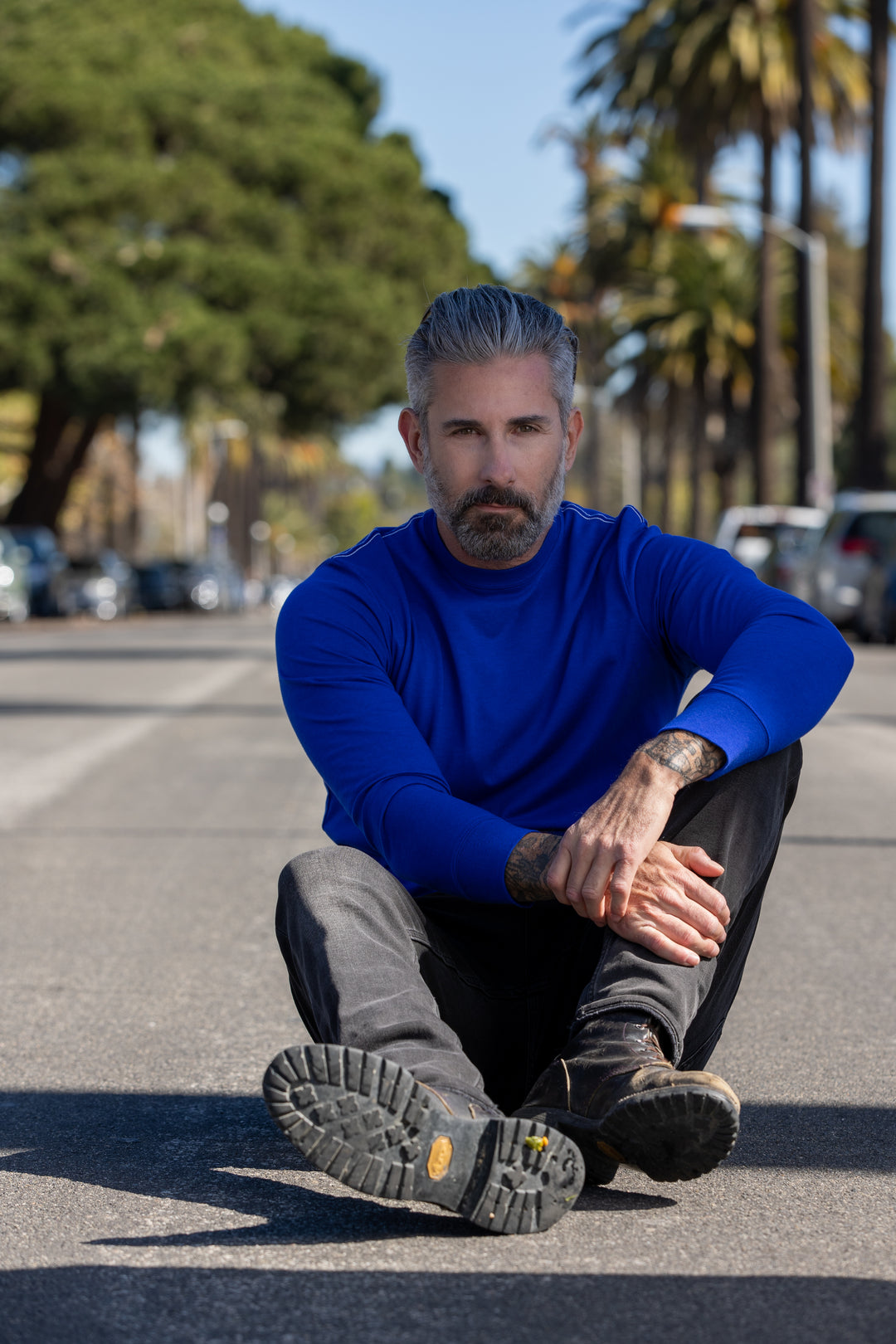
Editorial photography pulled directly from bambooclothes.com — the actual lookbook the brand publishes for each season.


Twelve picks from the catalog.
Spanning socks, underwear, basics, and the flagship henley fleece hoodie — what we'd buy first if we were rebuilding a bamboo-fiber wardrobe from scratch.

Men's Henley Style Bamboo Viscose Fleece Hoodie
The signature flagship. Bamboo-viscose terry fleece with henley placket — the brand's most-worn outer layer.

Men's Eco-Smart Full-Zip Bamboo Viscose Hoodie
Full-zip alternative to the henley. Hood, two zip pockets, ultralight bamboo-viscose blend.

No-Look Anklet Bamboo Viscose Socks (Black)
Top-selling sock SKU — 2,800+ pairs in inventory rotation. Bamboo viscose, no-show silhouette.

1/4 Crew Bamboo Viscose Socks
Quarter-crew height — natural anti-bacterial, temperature-regulating, the drawer-staple sock.

Women's Bamboo/Cotton High-Leg Brief Underwear
Top women's seller — 2,300+ in inventory. High-leg cut, cotton-bamboo blend, sized XS–XXL.

Men's Bamboo Viscose Briefs
Classic brief cut. Moisture-wicking bamboo viscose, contour-pouch fit, hypoallergenic.

Men's Bamboo Viscose/Cotton Boxer Underwear
Boxer cut for longer length and thigh coverage. Cotton-bamboo blend.

Women's Bamboo Padded Sports Bra (Black)
Light-support sports bra in black. Bamboo-poly blend, removable pads.

Men's Bamboo Viscose / Organic Cotton Tank Top
Sleeveless basic. Soft bamboo viscose / organic cotton — layering or solo.

Women's Bamboo Viscose / Organic Cotton Tank Top
Women's sleeveless basic — silk-soft hand-feel, longline cut.

Men's Bamboo Viscose / Organic Cotton Long Sleeve T-Shirt
Heavy-rotation winter base layer in true bamboo viscose / organic cotton blend.

Women's Bamboo Viscose Spaghetti Strap Camisole
Spaghetti-strap camisole — pull-on cami in featherweight bamboo viscose.
How the brand runs itself.
-
§01
FTC-compliant labeling, always.
Every Spun Bamboo garment ships with a label that reads viscose from bamboo per 16 CFR Part 303 — never 100% bamboo (which is illegal for a regenerated-cellulose fiber). The bamboo industry was hit with $1.26M in FTC enforcement against retailers in 2009 for that exact mislabeling; we have never been on that list.
-
§02
OEKO-TEX Standard 100 on the finished yarn.
The bamboo-viscose yarn used in Spun Bamboo's catalog is sourced from contract mill partners with OEKO-TEX Standard 100 certifications — meaning the finished fabric tests below the threshold for over 100 restricted-substance categories. Independently audited at the dye-finishing stage, not just the raw-fiber stage.
-
§03
Sized for real bodies.
Core basics run XS–4XL on most categories with published size charts on every product page. Hoodies, tees, and underwear are graded the same width-to-length ratio at every step — not just stretched-larger versions of an XS pattern. The catalog is cut for the actual range of US body sizes, not the fashion-industry ideal.
-
§04
30-day returns, you cover the label.
Returns are accepted within 30 days of delivery for any reason as long as the item is in like-new condition. Customer covers the return shipping label. Exchanges (size/color) ship back at no additional cost. Refunds processed within 5 business days of return arrival.
-
§05
Honest pricing, year-round.
Tags run $10–$120. Spun Bamboo runs seasonal sales (15% off for Mother's Day with code MOMD15, holiday capsules) but never invents scarcity to drive up everyday prices. The $69 fleece hoodie is the same garment we'd give our cousin — at the same price, with the same yarn count, off the same warehouse shelf.
Questions, answered straight.
What buyers actually ask before checkout — answered with the fiber-chemistry literacy this category requires.
+ Is bamboo clothing the same as bamboo viscose? Why does it matter?
No. The FTC's 16 CFR Part 303 rule (the Textile Fiber Products Identification Act) requires that fabric made from bamboo through the chemical viscose process be labeled viscose from bamboo or rayon from bamboo — NOT 100% bamboo. The reason: the chemical process (xanthation, then regeneration in sulfuric acid) destroys the original bamboo fiber and reconstitutes the cellulose into a new continuous filament. The output is a regenerated-cellulose fiber, chemically distinct from raw bamboo. In 2009 the FTC fined Macy's, Sears, Bed Bath & Beyond, and Leon Max a combined $1.26M for selling rayon products as bamboo. Spun Bamboo has labeled correctly since founding.
+ Who founded Spun Bamboo?
The brand was co-founded in 2007 by Olga Bautina and Kamila Manzo, both publicly named on the brand's about-us page. Both are environmentally-conscious women in the textile industry. The brand has held federal trademark registration USPTO Reg. No. 3,621,879 since the company's early days, and remains independently owned by the founders.
+ How does bamboo-viscose compare to bamboo lyocell (Tencel)?
Both are regenerated cellulose fibers from bamboo. The difference is the chemistry: viscose uses sodium hydroxide + carbon disulfide (xanthation), then sulfuric-acid regeneration — an open-loop process where solvents are partially recoverable. Lyocell (Tencel branded by Lenzing AG) uses N-Methylmorpholine N-oxide (NMMO) in a closed-loop process where ~99% of the solvent is recovered and reused. Lyocell is environmentally cleaner per process metrics; viscose is significantly cheaper per pound of fiber. Spun Bamboo runs viscose for cost-effective everyday basics.
+ What sizes does Spun Bamboo run?
Core basics (tees, tanks, underwear, sleepwear, henley hoodies) run XS through 4XL with published size charts on every product page. Sports bras and women's tops run XS–XXL on the new-arrival program. Socks come in S/M and L/XL. The catalog is sized for the actual US adult body range, not just the fashion-industry default. Length-to-width grading is consistent at each step (not just enlarged from an XS pattern).
+ What does the brand's 30-day return policy actually cover?
Spun Bamboo accepts returns within 30 days of delivery for any reason, as long as the item is in like-new condition with original packaging and tags. Customer covers the return shipping label. Exchanges (size/color of the same product) ship back at no additional shipping charge. Refunds process within 5 business days of the return package arriving at the warehouse — back to the original payment method or, for old purchases, by check.
+ Where is Spun Bamboo manufactured?
The bamboo viscose yarn and finished fabrics are produced at contract mill partners in China's bamboo-cultivation belt — disclosed because moso bamboo (Phyllostachys edulis) is geographically concentrated there. Final garment construction varies by category: socks, underwear, and basic tees are typically completed at the same partner; hoodies and structured pieces ship to a separate cut-and-sew partner. All finished yarn carries OEKO-TEX Standard 100 certification. Apparel ships from the US warehouse for North American orders.
+ How does the catalog grow each season?
Spun Bamboo's catalog now stands at 519 active SKUs — significantly grown from the brand's 2007 launch with a small sock + underwear assortment. New product programs roll out roughly twice per year (spring/summer and fall/winter), with the henley fleece hoodie, women's high-leg brief, and bamboo-viscose socks running as evergreens through the entire program.
Three long reads.
Primary-source-cited deep dives from the Spun Bamboo journal.
Bamboo Viscose, Chemically Explained: From Phyllostachys edulis to a Soft Tee — and Why It's Not the Same as Rayon, Modal, or Lyocell
A complete chemistry walkthrough of the four-step viscose process (alkali steep → xanthation → dissolution → regeneration), plus how bamboo viscose differs from modal, lyocell, and rayon-from-cotton-pulp. Cited from FTC 16 CFR 303, the Lenzing AG technical handbook, and the Stockholm Environment Institute's 2020 LCA.
REGULATION DECODEDWhy It's 'Viscose From Bamboo,' Not '100% Bamboo': The FTC Labeling Rules That Decide Honest Brands From Imitators
How the FTC's 16 CFR Part 303 rules on bamboo-fabric labeling work, the 2009 enforcement wave (Macy's, Sears, Bed Bath & Beyond, Leon Max — combined $1.26M settlement), the 2013–2015 follow-up letters, and a four-step buyer's compliance check.
BUYER'S GUIDEBamboo vs. Cotton for Everyday Essentials: A Sourced Comparison of Water, Pesticide, CO₂, Fabric Hand, and Wash Care
A sourced comparison of bamboo viscose vs. conventional cotton — water consumption (Water Footprint Network), pesticide load (USDA + FAO), CO₂ sequestration (INBAR), fabric hand (AATCC), wash-care durability, and a practical buyer's framework.
Wear it close.
Soft hand-feel, naturally hypoallergenic, biodegradable at end-of-life. Co-founded by Olga Bautina and Kamila Manzo on the conviction that bamboo viscose is the kindest fiber to skin — and seventeen years of catalog refinement to prove it.
Shop the Catalog