
In 1917 the US Flag Code made it illegal to wear the flag on clothing. By 2024 it's a $4B annual apparel category. Here's how Americana went from federal misdemeanor to summer wardrobe staple.
1917–1968: the flag-wearing-is-illegal era
The original 1917 US Flag Code (drafted during WWI) explicitly prohibited 'using the flag of the United States as wearing apparel.' This was reinforced in 1942 when President Roosevelt signed the Flag Code into permanent statute. Wearing actual American flag clothing during this period was, technically, a federal misdemeanor — though enforcement was rare and the law was treated as advisory rather than active.
The fashion implications: stars-and-stripes motifs (red/white/blue color schemes, eagles, abstract bunting patterns) appeared on patriotic clothing during both World Wars, but actual flag-print clothing was limited to formal flag bearers, color guards, and Boy Scout uniforms with specific flag-patch placement.
1968–1989: the protest-symbol era
Vietnam-era anti-war protesters began wearing American flag patches, t-shirts, and bandanas — sometimes upside-down, sometimes in protest contexts that the federal government tried to prosecute. Smith v. Goguen (1974) and Spence v. Washington (1974) reached the Supreme Court, which ruled that flag-symbol use in clothing was protected First Amendment expression. The Flag Code's prohibitions became largely unenforceable after these rulings.
By the late 1970s, flag-themed clothing had become rock-and-roll iconography (Bruce Springsteen's Born in the U.S.A. album cover, 1984; the Stars and Stripes leather jacket on countless rock musicians). The category had moved from protest to swagger.
1990s–2010s: mainstream commercial Americana
By the 1990s, big-box retailers (Walmart, Target, Macy's) carried full Fourth of July apparel collections every summer — flag-print tank tops, USA-letter graphic tees, stars-and-stripes accessories. The category had decoupled from political meaning and become seasonal commerce. By 2010, NRF (National Retail Federation) estimated US July 4th apparel spending at ~$680M annually.
The cultural shift in this period: Americana fashion stopped being read as political and became read as seasonal — same category as Christmas pajamas, Halloween costumes, Valentine's red. The neutralization of meaning made the category accessible to mass-market design.
2018–present: the boutique-driven Americana category
Southern boutique brands like Grace+Emma, Mainstreet Boutique, and others picked up Americana as a year-round design vocabulary in the late 2010s — not just July 4th but August college football, Memorial Day, Veterans Day, fall tailgates, county fairs. The category expanded from 'Fourth of July apparel' (June–July) to 'patriotic festive wear' (April–November in the south, May–September elsewhere).
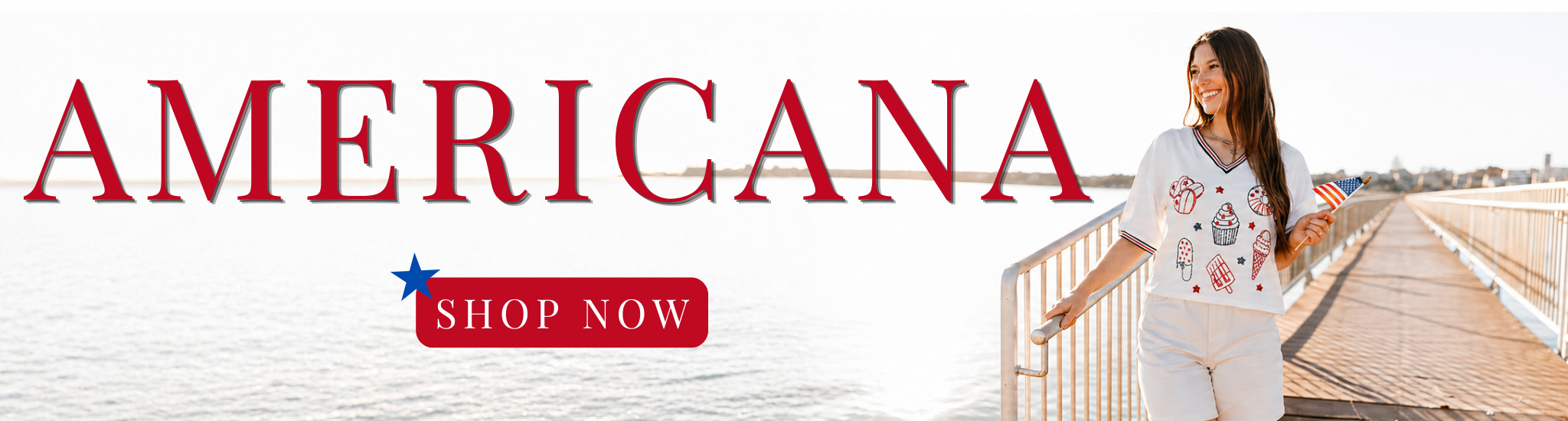
Grace+Emma's Sequin Americana V-neck, USA flag glitter stars top, navy stars rib tank, and patriotic popsicle enamel earrings represent this expansion. The category is no longer a single-week purchase — it's a wardrobe vertical.
Americana stopped being political in the 1990s and stopped being seasonal in the 2020s. It's now a year-round Southern fashion category.
Sources & citations
- United States Code, Title 4, Chapter 1 — "The Flag." Original 1917 statute, 1942 reaffirmation.
- Supreme Court. Smith v. Goguen, 415 U.S. 566 (1974). Spence v. Washington, 418 U.S. 405 (1974).
- National Retail Federation. "Independence Day Spending Surveys, 2010–2024." nrf.com
- Smithsonian National Museum of American History. "Politics and Fashion" exhibition archives.
- WGSN trend forecast. "Americana 2025: Beyond July 4th."
Discover more from Grace+Emma or browse the full Grace+Emma collection.
Frequently asked
What does "Americana Fashion: A Short History of How July Became a Wardrobe Category" cover?
This piece walks through the topic, context, and practical implications laid out in the article body above — focused on giving you a clear, sourced read rather than a quick listicle. Use it to deepen your understanding of the brand, category, or product family discussed.
Who is this article written for?
Readers shopping the brand or category covered, plus curious browsers researching independent makers stocked at Curated Sense. Both casual shoppers and trade buyers will find the same source-linked perspective.
How does Curated Sense vet the brands featured in journal articles?
Every brand in our journal has been onboarded directly: live inventory sync with the brand's own catalog, links back to the maker's own .com, and quality checks against return-rate, fulfillment-time, and customer-message-volume thresholds. We don't run sponsored placements in our journals.
Where can I shop the products discussed in this article?
Open the brand's collection or sub-collection page linked above to see current stock. Each product card opens a full Curated Sense product page with sizing, materials, the maker's own description, and the brand's live shipping policy.