
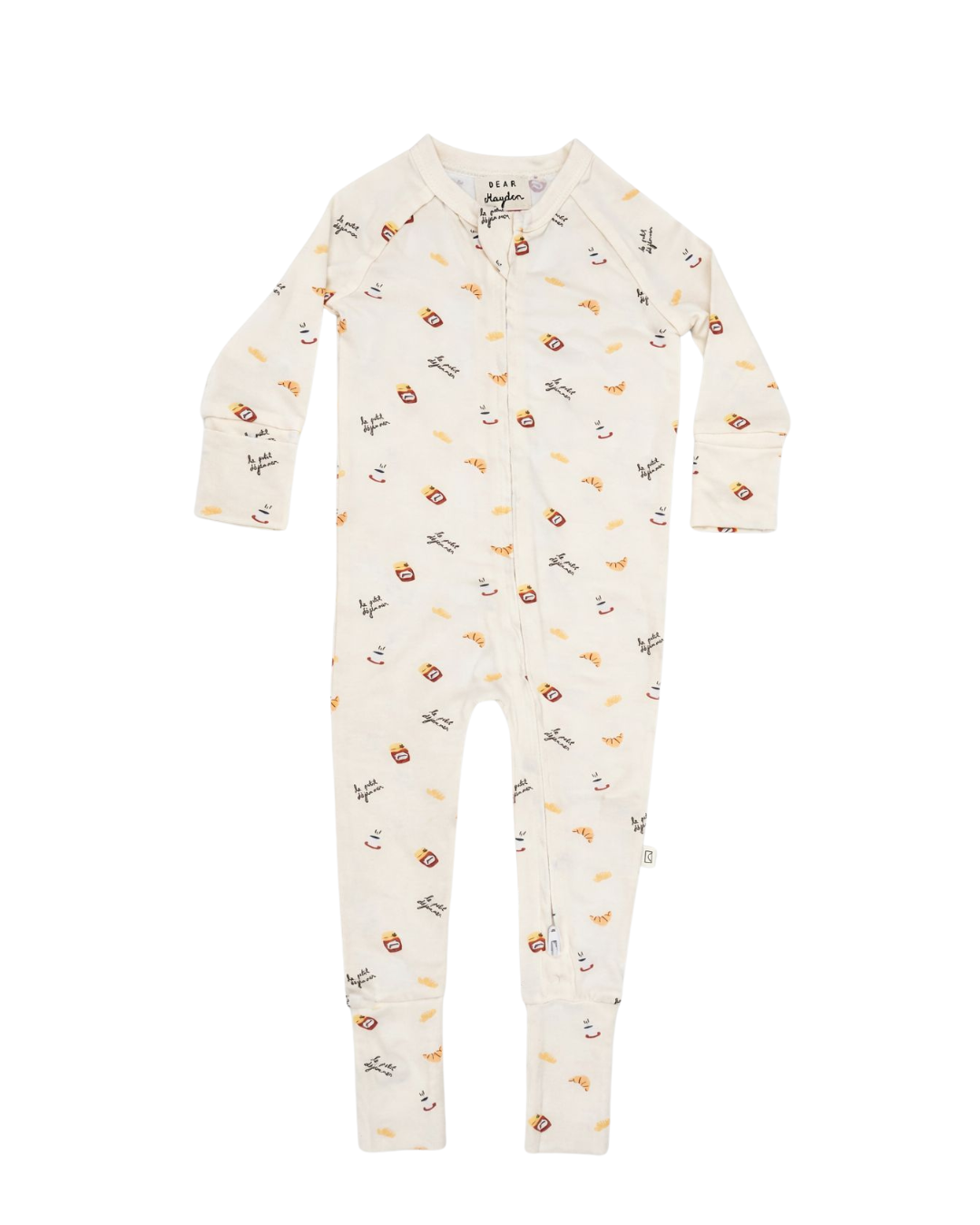
A fabric tag that reads '95% modal, 5% elastane' has answered exactly nothing — modal is a category, not a specification. The same is true for Tencel and for organic cotton. Here's the field guide.
Modal: beech tree pulp, dissolved and respun
Modal is a regenerated-cellulose fiber made from the pulp of European beech trees (most commonly Fagus sylvatica). The pulp is dissolved in a chemical bath, extruded through tiny holes into a fiber, washed, and spun. The result is technically a 'semi-synthetic' — the molecule is cellulose (same as cotton), but the fiber structure is engineered.
What this means for performance: modal is 50% more absorbent than cotton (it can hold its weight in moisture without feeling damp), 30% softer to the touch (the engineered surface is smoother), and significantly more colorfast (the dye bonds during the regeneration step rather than coating the surface). Modal is what most luxury baby pajamas are made of for these reasons.
Tencel® Lyocell: eucalyptus, but cleaner
Tencel is a brand name owned by the Austrian company Lenzing AG. The generic term is 'lyocell' and the source pulp is most commonly eucalyptus (specifically Eucalyptus globulus, fast-growing on marginal land). What distinguishes Tencel from generic lyocell is the closed-loop manufacturing process: 99.5% of the chemical solvent is recovered and reused, instead of dumped.
Performance-wise: Tencel is more durable across washes than modal (the fiber structure has higher tensile strength), is naturally moisture-wicking and antibacterial (the smooth surface gives bacteria fewer attachment points), and has slightly less stretch than modal — which makes it better for fitted garments and slightly stiffer for loose ones.
Organic cotton: the most familiar
Organic cotton is the natural fiber most people grew up wearing. It's grown without synthetic pesticides on rotation-managed soil, harvested by hand or machine, ginned to remove seeds, and spun into yarn. There's no chemical regeneration step — the fiber is what the plant produced.
Performance: cotton is the most breathable of the three (the fiber has natural capillary spaces between fibrils that wick air). It's also the least colorfast (dye sits on the surface) and the least absorbent without specialized treatment. For hot sleepers and humid climates, cotton wins. For dry climates with cold nights, modal or Tencel wins.
How to pick by sleep profile
- Hot, sweaty sleeper: organic cotton — most breathable, most familiar
- Cold, dry sleeper: modal — softest hand, traps a thin warm layer
- Eczema or sensitive skin: Tencel — naturally antibacterial, smoothest surface, least irritation
- Wears out fast (toddler crawler): Tencel — most durable across washes
- Hand-me-down candidate: organic cotton — softens over time, takes patches well
- Hot sleeper in cold climate: Tencel/modal blend — moisture-wicks while staying warm
What to avoid (regardless of fiber)
Three things flag a pajama that won't last: (1) 'wrinkle-free' or 'no-iron' on the label — those finishes are usually formaldehyde-based and outgas for months; (2) any blend with more than 8% polyester — polyester pills, the pilling traps lint, the lint traps detergent, and the garment irritates skin within 5–10 washes; (3) 'antimicrobial' as a marketing claim — most antimicrobial finishes use silver nanoparticles or triclosan, both of which wash out within 20 cycles and end up in waterways.
The fiber doesn't matter as much as the finishing. A formaldehyde-finished organic-cotton pajama is worse than a properly-finished polyester one.
Sources & citations
- Lenzing AG. "Tencel manufacturing process technical brief." tencel.com
- Lenzing AG. "Modal — beech wood-based fiber." lenzing.com
- Textile Exchange. "Preferred Fiber Materials Market Report 2024."
- Schweppe, H., et al. (2017). "Comparative tensile and washing-fatigue analysis of regenerated-cellulose fibers." Textile Research Journal, 87(10), 1158-1175.
- OEKO-TEX. "Formaldehyde in textile finishing — testing protocols." oeko-tex.com
Discover more from Dear Hayden or browse the full Dear Hayden collection.
Frequently asked
What does "Modal vs Tencel vs Organic Cotton: A Fiber Guide for Choosing Baby Pajamas" cover?
This piece walks through the topic, context, and practical implications laid out in the article body above — focused on giving you a clear, sourced read rather than a quick listicle. Use it to deepen your understanding of the brand, category, or product family discussed.
Who is this article written for?
Readers shopping the brand or category covered, plus curious browsers researching independent makers stocked at Curated Sense. Both casual shoppers and trade buyers will find the same source-linked perspective.
How does Curated Sense vet the brands featured in journal articles?
Every brand in our journal has been onboarded directly: live inventory sync with the brand's own catalog, links back to the maker's own .com, and quality checks against return-rate, fulfillment-time, and customer-message-volume thresholds. We don't run sponsored placements in our journals.
Where can I shop the products discussed in this article?
Open the brand's collection or sub-collection page linked above to see current stock. Each product card opens a full Curated Sense product page with sizing, materials, the maker's own description, and the brand's live shipping policy.