
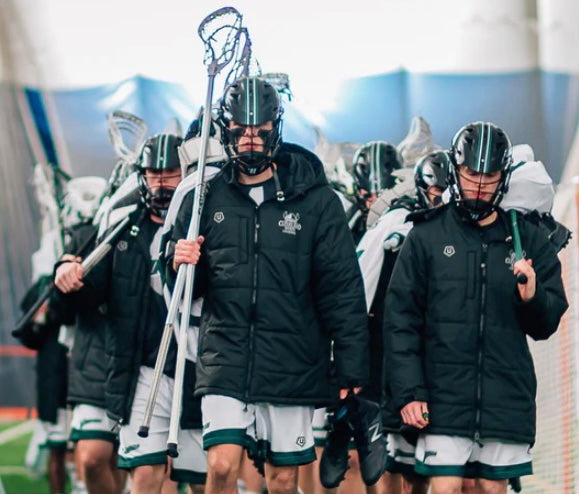
Most sports give you a uniform and that's it. Hockey gives you four uniforms — arrival attire, warmup top, on-ice gear, post-game. The 90 minutes between locker-room walk-in and puck drop is a specific cultural ritual, and it sells around $400M in apparel a year. Here's what's happening.
The 90-minute timeline
At higher levels (junior, college, pro), players arrive at the rink ~90 minutes before puck drop. The standard sequence: enter in 'arrival attire' (suit and tie at most levels above youth), greet teammates, change into warmup wear (the layer Cloche designs for), head to the trainer's room, do dynamic-warmup work, then skate-warmup on ice in actual gear. The warmup-wear period is roughly 25–40 minutes of the window.
What makes the ritual unusual is the visibility. Locker rooms have media, organizational staff, family on suite-tour evenings, and increasingly social-media-content-creators with phones. Players are dressed but unguarded for 30+ minutes per game. What you wear in that window gets photographed — for team Instagram, for personal feeds, for journalism.
Why hockey arrival-attire is uniquely formal
The dress-code-on-arrival convention is more rigorous in hockey than any other major North American sport. NFL teams started enforcing arrival attire in the 2010s but it's still individualistic. NBA arrival went full streetwear-fashion in the 2010s and stayed there. NHL arrival is still suit-and-tie at most levels and gets enforced internally — coaches, captains, and team-rules documents specify it.
The cultural reason isn't fully documented but tracks to hockey's Canadian origins (where 1950s-era 'gentleman amateur' codes set the template) and the sport's lower-television-celebrity profile (which kept the conventions ossified longer). The functional reason is logistics: hockey games happen in cold buildings often with media in the parking lot; suit-and-tie is warmer and more photographable than streetwear in a Manitoba February.
Where Cloche fits
The transition window from arrival-attire to on-ice gear is where Cloche's catalog lives. The Vantage Performance Long-Sleeve and Short-Sleeve are the warmup-layer pieces — sized to fit under partial padding (or over a base layer), cut to look athlete-fitted in locker-room photos, fabric-engineered for the body-temp swings that happen as you move from warm hallway to cold ice.
The Momentum Hoodie and Selke Polo are arrival-attire alternates for less-formal contexts (junior team road games, college club play, beer-league seasons where suit-and-tie isn't enforced). The Original Six Jogger and Dynasty Short are post-game and travel pieces — what you change into after the game-gear comes off but before you go home.
The market
Sports-business analysts (SportsBusiness Journal, Sports Innovation Lab) estimate the hockey-warmup-and-arrival apparel market at roughly $400M annually in North America, growing about 8–12% per year as youth-and-junior hockey participation expands and as social-media documentation of locker-room content increases the visibility incentive. Major brands serving the category include Bauer Lifestyle, Warroad Hockey, RinkedIn, and Cloche.
What distinguishes Cloche from the larger competitors: smaller catalog (7 SKUs vs Bauer's 200+), founder-led design (both Jake and Gavin still play and use the products), and a deliberately niche audience (hockey players, not 'hockey-aesthetic' streetwear customers). The niche-positioning is the strategy — Cloche isn't trying to sell to non-hockey-players.
Shop the warmup tops
Vantage Performance LS, Momentum Hoodie, Selke Polo — built for the 90-minute pre-game window.
Sources & citations
- SportsBusiness Journal. "Hockey Apparel Market Analysis 2024." sportsbusinessjournal.com
- Sports Innovation Lab. "The Athlete-Driven Apparel Brand Report" (2023).
- NHL Players' Association — published team-rules documents on arrival-attire conventions. nhlpa.com
- Cole, B. T. (2018). Hockey Culture and the Performance of Tradition. Wilfrid Laurier University Press.
- Cloche Hockey founders interview (clochehockey.com/blogs/news/about-us).
All performance tops
The full Cloche Hockey lineup at Curated Sense — every piece engineered for hockey's 90-minute warmup window.
All performance tops →Discover more from Cloche Hockey or browse the full Cloche Hockey collection.
Frequently asked
What does "The Hockey Warmup Window: A 90-Minute Ritual That Sells $400M in Apparel" cover?
This piece walks through the topic, context, and practical implications laid out in the article body above — focused on giving you a clear, sourced read rather than a quick listicle. Use it to deepen your understanding of the brand, category, or product family discussed.
Who is this article written for?
Readers shopping the brand or category covered, plus curious browsers researching independent makers stocked at Curated Sense. Both casual shoppers and trade buyers will find the same source-linked perspective.
How does Curated Sense vet the brands featured in journal articles?
Every brand in our journal has been onboarded directly: live inventory sync with the brand's own catalog, links back to the maker's own .com, and quality checks against return-rate, fulfillment-time, and customer-message-volume thresholds. We don't run sponsored placements in our journals.
Where can I shop the products discussed in this article?
Open the brand's collection or sub-collection page linked above to see current stock. Each product card opens a full Curated Sense product page with sizing, materials, the maker's own description, and the brand's live shipping policy.