
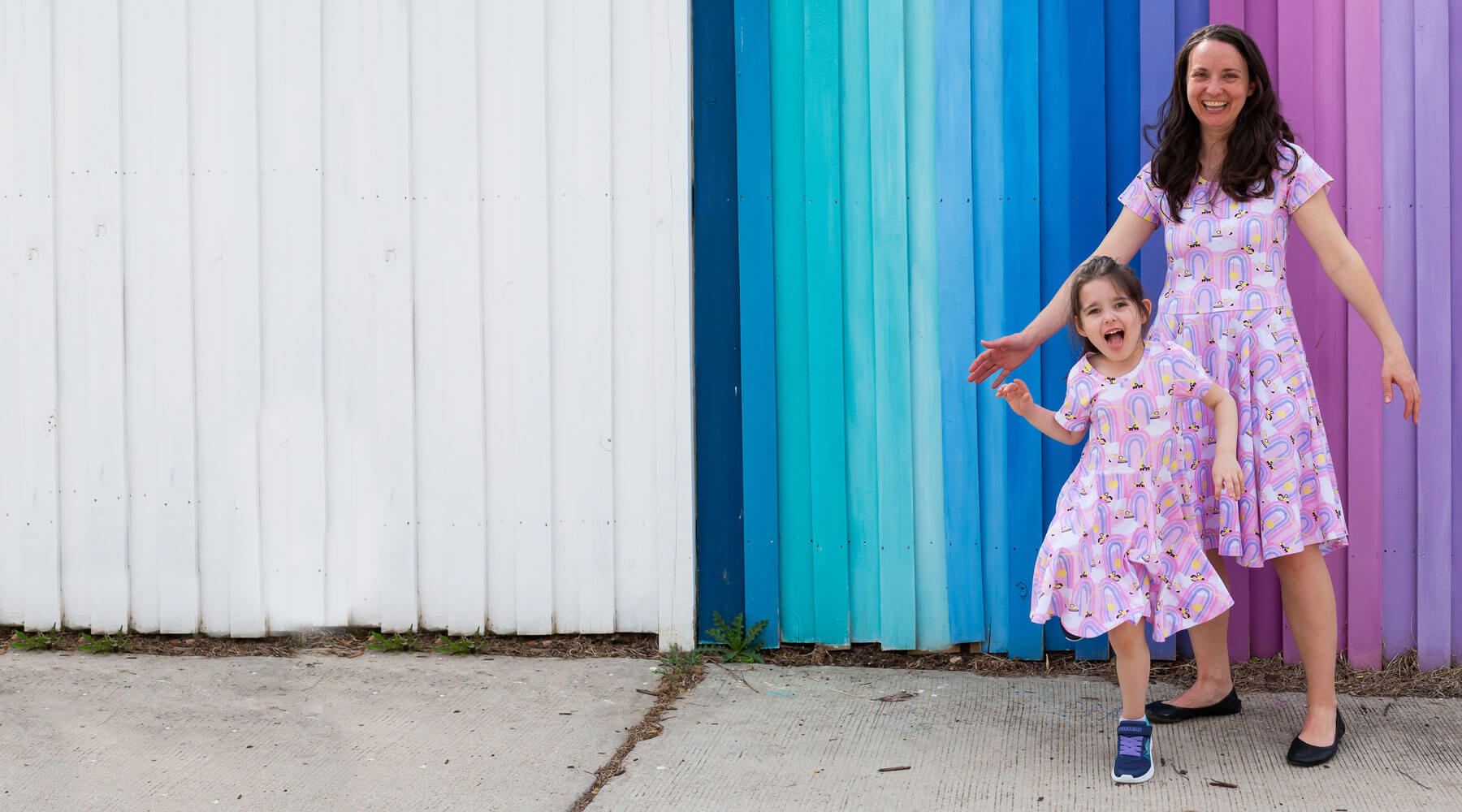
What a kid wears isn't fashion. It's a costume rehearsal for an identity. Here's the research showing why STEM-themed clothing isn't just a cute marketing angle — it's an early-childhood intervention with measurable effects on stereotype threat, career interest, and self-concept.
The 'pervasiveness effect' in identity formation
When developmental psychologists try to explain why kids self-sort into gendered career interests well before middle school, they keep returning to one finding: identity messages stick when they're pervasive — when they appear across toys, books, classroom posters, parent comments, and yes, clothing. A 2017 study in Frontiers in Psychology tracked 4–6 year olds across 12 weeks and found that a single intervention (a STEM-themed book) moved attitudes; pairing the book with STEM-themed clothing and parent dialogue moved them and held them.
The mechanism is what researchers call self-categorization. A four-year-old asked 'who am I?' answers in concrete observable terms: 'I'm the kid with the dinosaur dress.' That sentence quietly carries a payload — the kid chose a dinosaur, the kid is okay with dinosaurs, dinosaurs are part of this kid's category. The identity isn't the clothing; the clothing is the evidence the kid uses to ratify the identity.
Stereotype threat starts earlier than most parents think
Claude Steele's stereotype-threat research is often discussed in the context of standardized testing in adults — the documented finding that women perform worse on math tests when reminded of their gender immediately beforehand. But the developmental literature shows the seed of that effect is planted much earlier.
A widely-cited 2017 study by Bian, Leslie, and Cimpian (published in Science) found that by age 6, girls were already less likely than boys to associate 'really, really smart' with their own gender, and were more likely to avoid games described as for 'really smart' children. The researchers were careful to note the cause isn't innate — it's environmental signal, accumulated.
It's not that 6-year-old girls believe they aren't smart. It's that they've already learned 'smart' isn't socially safe to claim.
What clothing does that toys can't
Toys live in a toy box. A dinosaur dress lives on the kid, in front of the camera, at preschool drop-off, at the grocery store, in family photos. The breadth of audience exposure changes what kind of psychological work the object does.
Sociologists studying gender expression in early childhood describe clothing as 'social-context evidence' — the kind of personal artifact a child uses to negotiate group membership at the playground. A girl wearing a t-rex dress isn't just expressing herself; she's recruiting other kids into the version of girl-ness where dinosaurs are normal. That recruitment is, structurally, what shifts cohort norms over time.
What this means for buying decisions
If you're a parent, this isn't an argument that you must buy STEM-themed clothes. It's an argument that the clothes a kid asks for are doing identity work — so when they ask for the dinosaur dress instead of the floral one, the answer 'sure' is doing more than indulging a preference.
It's also an argument for variety. The most psychologically protective wardrobe isn't 100% STEM or 100% princess — it's a wardrobe where the kid sees, every day, that both are normal and both are theirs to choose.
- Stock both ends of the spectrum and let the kid mix
- Validate the choice ("that's a great print") without over-praising — over-praise reads as 'this is unusual'
- Buy across categories — STEM-themed pajamas matter as much as STEM-themed dresses
- Family-matching pieces reinforce the message at the parent level too
Quick answers
Does what a 4-year-old wears actually change what they believe they can be?
The evidence is clearer than people assume. A 2014 study in Child Development showed children as young as 5 hold gendered career stereotypes — but those stereotypes shifted after sustained exposure to counter-stereotypical imagery, including clothing and books. The effect was strongest in children whose parents reinforced the imagery verbally.
Are STEM-themed clothes more impactful than STEM toys?
Not more — additive. A child who plays with chemistry sets but wears only floral dresses is getting mixed signals. Researchers describe this as the 'pervasiveness effect' — identity messages stick when they appear across multiple contexts. Clothing is one of the most pervasive contexts of all.
Doesn't this argument apply to boys too?
Yes — and Princess Awesome's Boy Wonder line addresses exactly this. The same psychological mechanism that limits girls' interest in STEM also limits boys' interest in caregiving roles, the arts, and emotional fluency. Pink-and-sparkle on boys' clothing isn't a punchline; it's the same intervention.
Shop the STEM Themes collection
Books, galaxies, Fibonacci, dragons — the prints kids point at when they want to be the smart one in the room.
Sources & citations
- Bian, L., Leslie, S.-J., & Cimpian, A. (2017). "Gender stereotypes about intellectual ability emerge early and influence children's interests." Science, 355(6323), 389–391. science.org/doi/10.1126/science.aah6524
- Steele, C. M. (1997). "A threat in the air: How stereotypes shape intellectual identity and performance." American Psychologist, 52(6), 613–629. NCBI: pubmed.ncbi.nlm.nih.gov/9174398
- Master, A., Cheryan, S., & Meltzoff, A. N. (2017). "Social group membership increases STEM engagement among preschoolers." Frontiers in Psychology. frontiersin.org
- AAUW (American Association of University Women). "Why So Few? Women in Science, Technology, Engineering, and Mathematics." aauw.org/resources/research/why-so-few
All STEM Themes
The full Princess Awesome lineup at Curated Sense — same prints, same pockets, ready to ship.
All STEM Themes →Discover more from Princess Awesome & Boy Wonder or browse the full Princess Awesome & Boy Wonder collection.