
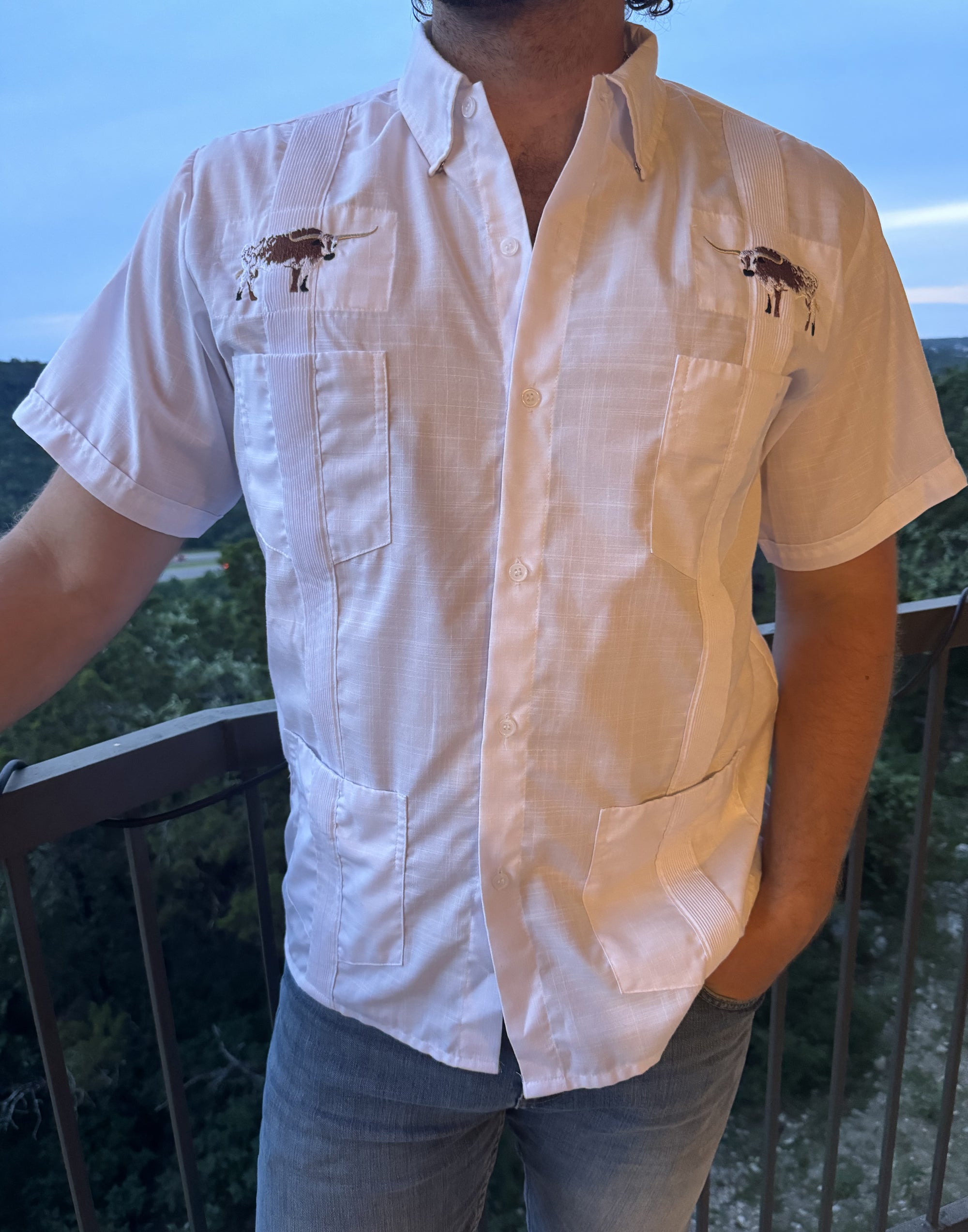
You've been to a wedding in one. Or a confirmation. Or a 100-degree Texas backyard barbecue. The guayabera is the answer to a specific menswear problem — how do you stay formal without losing your mind in the heat — and it's been the answer for at least 150 years.
The disputed origin
Multiple Latin American countries claim the guayabera. The most-cited origin story places it in Cuba in the 1820s — the wife of a tobacco worker reportedly sewed extra pockets onto her husband's shirt to carry guava (guayabas) home from the field. Other origin claims place it in the Yucatán Peninsula of Mexico (where Mayan cotton-shirt traditions predate Spanish colonization), in the Philippines (where Spanish-colonial influence produced parallel four-pocket button-fronts), and in Veracruz (the Mexican state with the strongest current guayabera-manufacturing tradition).
What's documented: by 1850, the four-pocket pleated cotton shirt was widely worn across Cuba, the Yucatán, Veracruz, and the Caribbean island arc as casual-formal warm-weather menswear. By 1900, it had spread to Florida, the Texas Gulf Coast, and Louisiana — wherever Latin American immigration carried it. By the 1950s, it was standard Mexican-presidential and Caribbean-presidential formal wear (Fidel Castro frequently wore them; so did multiple Mexican presidents; so did Jimmy Carter on diplomatic visits).
What makes a real guayabera
- Four front pockets — two upper, two lower; the upper pockets often have a buttoned flap, lower don't
- Vertical alforza pleats — typically 2–4 sets of vertical pleats running down the front and back, decorative but signature
- Side vents at the hem — short slits at each side seam to allow heat dissipation when worn untucked
- Worn untucked — formal in many Latin contexts despite the shirt-tail-out style; a tucked-in guayabera is a tourist's mistake
- Cotton or linen — heavyweight cotton in the formal Mexican tradition, lighter linen in the Caribbean and Filipino versions
- Long or short sleeves — long-sleeve is more formal, short-sleeve more casual; both are appropriate
The American Duke take
American Duke makes the cut traditionally — four pockets, alforza pleats, side vents, designed to be worn untucked — but prints them in Texas-state motifs (Longhorns, Yellow Rose, Burnt Orange and Maroon Barbed Wire, Purple Gingham, Sirens). Manufacturing happens in Mexico where guayaberas have been made for 200+ years, then the brand finishes them and ships from Texas.
The Texas-print guayabera isn't an appropriation; it's a direct nod to Texas's deep Mexican-American heritage. The Treaty of Guadalupe-Hidalgo (1848) made Mexican land Texas; Spanish predates English in San Antonio; the guayabera was already widely worn across the Texas Gulf Coast in the 1880s, decades before air conditioning. American Duke's print is an Anglo-Texas-pride layer on a Mexican-Texas-heritage base — which is what most things in Texas are.
The guayabera is a Mexican shirt. Texas Longhorns are a Texas-state motif. Both are at home together because both are at home in Texas.
Shop the Texas Guayabera collection
The article you just read in real life — six Texas-print guayaberas, cut traditionally in Mexico, ready to ship.
Sources & citations
- Hicks, K. R. (2016). "The Cuban Origin Hypothesis: A Material History of the Guayabera." Journal of Latin American Studies, 48(3), 587–612.
- Universidad de Yucatán. "Historia de la guayabera yucateca" (Department of Cultural Studies archive). uady.mx
- Smithsonian Center for Folklife and Cultural Heritage. "Guayabera: A Cultural Garment." folklife.si.edu
- Mexican Cultural Institute, Washington DC. "The Guayabera in Mexican Diplomatic History."
- Texas State Historical Association. "Mexican-American Cultural Influences in Texas, 1820–Present." tshaonline.org
All guayaberas
The full lineup at Curated Sense — all American Duke pieces in this category, in stock and ready to ship.
All guayaberas →Frequently asked
What does "A Short History of the Guayabera: Mexico's Gift to Saturday-Formal Menswear" cover?
This piece walks through the topic, context, and practical implications laid out in the article body above — focused on giving you a clear, sourced read rather than a quick listicle. Use it to deepen your understanding of the brand, category, or product family discussed.
Who is this article written for?
Readers shopping the brand or category covered, plus curious browsers researching independent makers stocked at Curated Sense. Both casual shoppers and trade buyers will find the same source-linked perspective.
How does Curated Sense vet the brands featured in journal articles?
Every brand in our journal has been onboarded directly: live inventory sync with the brand's own catalog, links back to the maker's own .com, and quality checks against return-rate, fulfillment-time, and customer-message-volume thresholds. We don't run sponsored placements in our journals.
Where can I shop the products discussed in this article?
Open the brand's collection or sub-collection page linked above to see current stock. Each product card opens a full Curated Sense product page with sizing, materials, the maker's own description, and the brand's live shipping policy.